Almost nobody walks into a first meeting with us and asks, “Which types of digital marketing should we be using?”
They say something closer to: “We tried Instagram. It didn’t work.” Or: “We put ₹40,000 into Google Ads and got two calls, and one of them was someone trying to sell us software.”
Neither of those is really a channel problem. Instagram didn’t fail, and Google Ads didn’t fail. What usually happened is that someone picked a channel before deciding what job it had to do. Then they gave it a budget too small to produce a clear answer, and judged it against the wrong number.
So this guide does two things. First, it walks through the 14 types of digital marketing that matter for Indian businesses right now: what each one is, roughly what it costs, how long it takes, and where it tends to break. Second, it gives you a way to choose, because a list of channels on its own helps about as much as a list of ingredients with no recipe.
Those numbers explain why every business is being told to “go digital”. They don’t tell you which part of digital. That’s what the rest of this page is for.
What digital marketing actually means
Strip away the jargon and digital marketing is any marketing that reaches people through a screen and leaves a trail you can measure. That covers a Google search result, an Instagram Reel, a WhatsApp message, a YouTube pre-roll and a newsletter.
Three things make it different from a hoarding on Outer Ring Road or a half-page ad in the newspaper:
- You can choose who sees it. A newspaper ad reaches everyone who buys that paper. A Google ad for “physiotherapist near Koramangala” reaches only people in pain who are looking for help nearby, right now.
- You can see what happened. Clicks, calls, form fills, sales and the cost of each one. Not perfectly, but well enough to make decisions.
- You can change it on Tuesday. If an ad isn’t working, you can rewrite it before lunch. Try that with a print run.
The catch is that all three advantages only show up if you set things up to capture them. A lot of businesses run digital campaigns the way they ran print: launch, hope, and look at the bank balance at the end of the month. That approach wastes the one thing digital is actually good at.
Owned, earned, paid and rented: the map that makes everything simpler
Before going channel by channel, it helps to sort them into four boxes. The box a channel sits in tells you who controls the result, which matters more than people think.
Here’s why this matters in practice. We’ve watched businesses build 40,000 Instagram followers and then see reach collapse after an algorithm change. They had built on rented land. We’ve also seen businesses switch off ads during a slow quarter and have enquiries drop to near zero the next day, because everything depended on paid traffic.
The healthiest marketing setups we work with use paid and rented channels to grow faster, but keep pulling customers into owned channels: the website, the email list, the WhatsApp contact list. Over time they build earned assets too, such as rankings, reviews and press mentions, that keep working when the budget is tight.
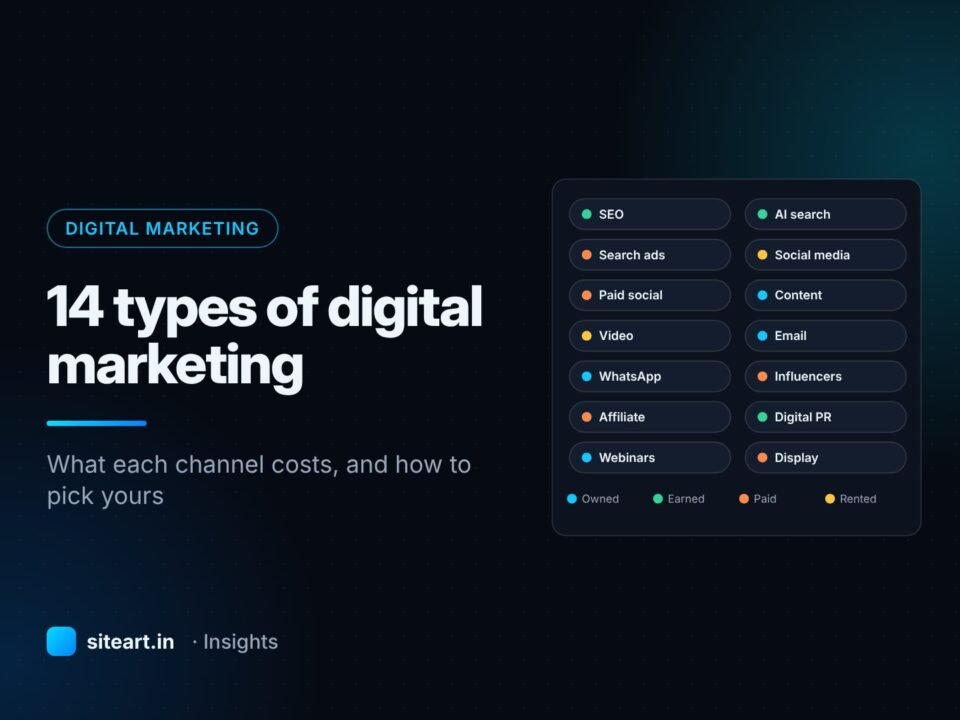
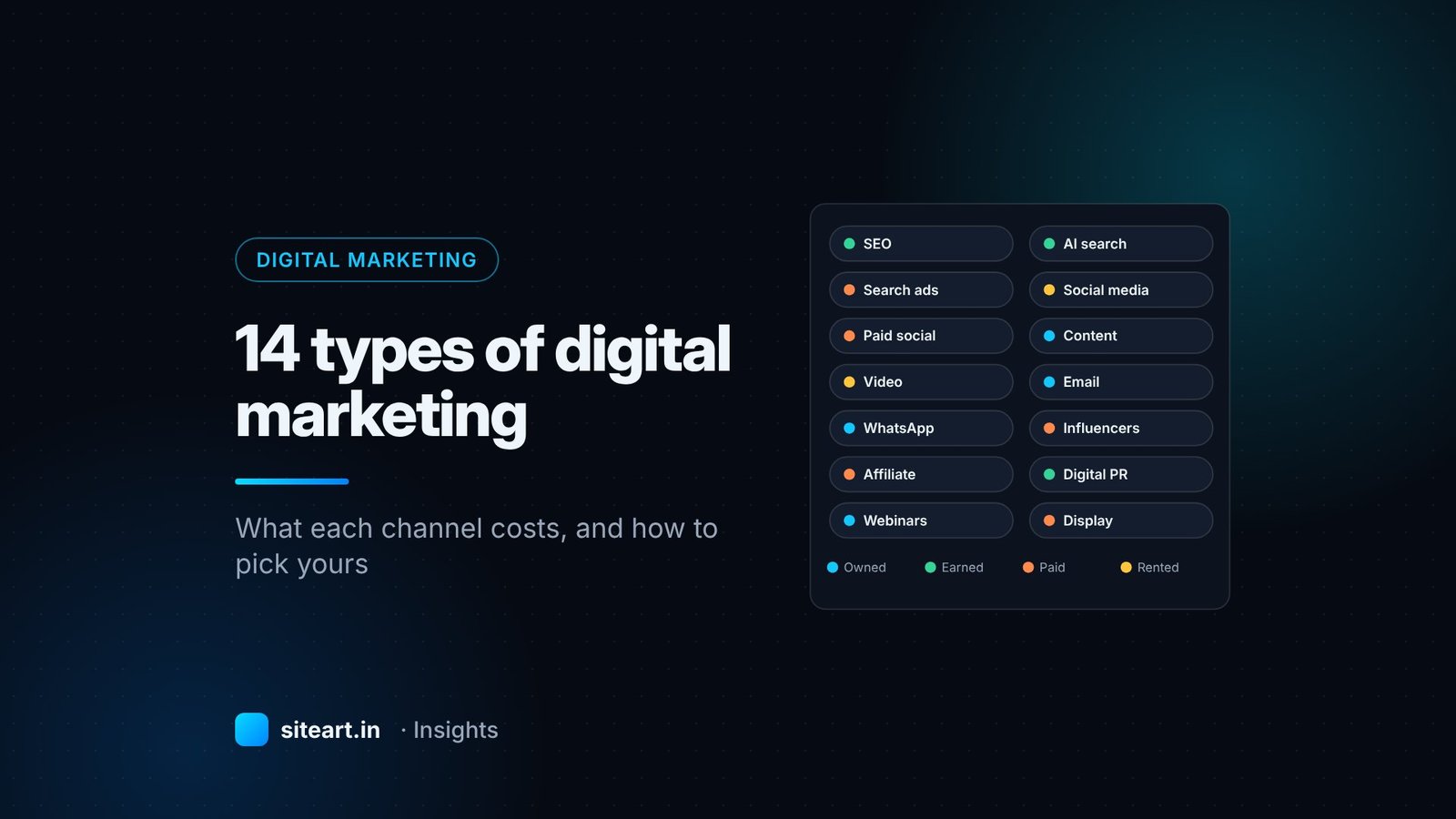
All 14 types of digital marketing at a glance
Use this table as a quick reference, then read the sections for the channels that look relevant to you.
| # | Channel | What it does best | First real results | Ballpark monthly cost (India) | Effort |
|---|---|---|---|---|---|
| 1 | SEO | Captures people already searching for what you sell | 3–6 months | ₹20k–₹1.5L (agency retainer) | High, ongoing |
| 2 | AI search (AEO/GEO) | Gets you named in ChatGPT, Gemini and Google AI answers | 2–6 months | Usually bundled with SEO and content | Medium |
| 3 | Search ads (PPC/SEM) | Puts you on top of Google for buying-intent searches | Days | ₹30k+ ad spend, plus management | Medium |
| 4 | Organic social media | Builds familiarity and trust over time | 3–6 months | ₹25k–₹1L (content production) | High |
| 5 | Paid social and performance | Creates demand and scales offers that work | 1–3 weeks | ₹25k+ ad spend, plus creative | Medium–high |
| 6 | Content marketing | Answers buyer questions and feeds every other channel | 3–9 months | ₹4k–₹15k per in-depth article | High |
| 7 | Video marketing | Explains, demonstrates and builds trust quickly | Weeks to months | ₹5k–₹30k per short video | Medium–high |
| 8 | Email and automation | Turns leads into buyers and buyers into repeat buyers | 4–8 weeks | ₹0–₹10k (tools) | Low–medium |
| 9 | WhatsApp and mobile | Fast replies, reminders, reorders | Days | Platform fee + per-message charges | Low–medium |
| 10 | Influencer marketing | Borrowed trust and reach | 2–6 weeks | ₹5k–₹50k per nano or micro creator | Medium |
| 11 | Affiliate marketing | Pays only when a sale or lead happens | 1–3 months | Commission, often 5–20% | Medium |
| 12 | Digital PR | Credibility, links and mentions that AI tools pick up | 1–3 months | ₹30k–₹2L (retainer) | Medium |
| 13 | Webinars and virtual events | High-intent B2B leads and education | 4–8 weeks | Tool cost + promotion | Medium |
| 14 | Display, native and programmatic | Reach at scale and retargeting | Days | ₹1L+ to be meaningful | Medium |
1. Search Engine Optimization (SEO)
SEO is the work of making your pages the obvious answer when someone searches for what you sell. It has three parts. Technical SEO asks whether Google can find, crawl and load your pages quickly. On-page SEO asks whether each page clearly answers what the searcher wanted. Authority asks whether other credible sites mention you and link to you.
For any business with a physical location there’s a fourth part, and it often matters more than the other three combined: local SEO. That means your Google Business Profile, your reviews, and whether your name, address and phone number match everywhere they appear online.
Why it’s still worth doing
Someone typing “CA firm for GST filing in HSR Layout” already has the problem. You don’t have to convince them they need a CA. You only have to show up and look like the right one. Ranking for searches like that sends steady, free enquiries month after month, and the cost per lead keeps falling the longer the page holds its position.
Where it struggles
- Brand-new product categories that nobody is searching for yet.
- Businesses that need leads this month. SEO won’t save a bad quarter.
- New websites trying to rank nationally for short, broad terms like “insurance” or “interior design”.
What we look at first on any site
- Google Search Console’s Pages report. How many pages has Google actually indexed, compared with how many you think you have? It’s surprisingly common to find half the service pages excluded, because of a “noindex” tag left over from the staging site or because the pages are near-copies of each other.
- Whether each service has its own page. A single “Services” page listing eight services can’t rank for eight different searches. One page, one intent.
- The primary category on your Google Business Profile. It shapes map rankings more than most owners realise. “Dentist”, “Dental clinic” and “Cosmetic dentist” are different categories. Pick the one people actually search for.
- Page speed on a mid-range Android phone over mobile data. Not on the office Wi-Fi with a new MacBook. Most of your visitors are on the phone.
Measure it by: clicks and impressions for non-branded searches in Search Console, calls and direction requests from your Business Profile, and leads that start on organic landing pages. Not screenshots of “rank #1” for a keyword nobody searches.
If you sell products online, the same logic applies to category and product pages. Our e-commerce SEO work is mostly about that. For service businesses, see how we approach SEO.
2. AI search optimization (AEO and GEO)
This is the newest item on the list, and it is no longer optional. A growing share of questions now get answered before anyone clicks a link: in Google’s AI Overviews and AI Mode, and in ChatGPT, Gemini and Perplexity. That’s especially true of “which one should I choose” questions. AEO (answer engine optimization) and GEO (generative engine optimization) are two names for the same job: making sure your business is the one those answers mention.
In practice, it’s SEO with a few different priorities:
- Clear, quotable answers near the top of your pages. A direct 40–60 word answer to the question, then the detail. AI systems lift these almost word for word.
- Facts a machine can check. Consistent business details everywhere, real prices or price ranges, named people with real credentials, dates on content.
- Mentions on other websites. Directories, comparison articles, news coverage, forum threads. Language models lean heavily on what the wider web says about you, not just on what you say about yourself.
- Structured data (schema). It helps machines read your page the way you intended.
We’ve written a separate guide on this: AEO and GEO explained: how to get cited in AI answers.
3. Search ads (PPC and SEM)
Google Ads lets you pay to appear at the top of search results, and you pay only when someone clicks. It’s the fastest way to reach people who are ready to buy. Strictly speaking, SEM (search engine marketing) covers both paid and organic search, but in everyday use most people mean paid search ads.
Search ads usually work. When they don’t, the cause is nearly always one of these four:
- Broad keywords with no exclusions. “Interior designer” can trigger ads for “interior designer jobs”, “interior design course fees” and “interior designer salary”. None of those people want to hire you. A proper negative keyword list is the cheapest fix in all of marketing.
- Every click goes to the homepage. Someone searching “modular kitchen price for 2BHK” should land on a page about modular kitchen prices for a 2BHK, not a homepage slider.
- Tracking counts the wrong thing as a lead. If a page view or a click on the “Contact” menu counts as a conversion, Google’s automated bidding will happily find you more people who do exactly that, and nothing else.
- The budget is too thin to learn anything. In many competitive local categories a click costs anywhere from ₹30 to well over ₹100. At that rate ₹10,000 a month buys maybe 100–300 clicks. That’s not enough for the algorithm to learn from, or for you to judge.
| Google Ads campaign type | Use it when | Watch out for |
|---|---|---|
| Search | People actively search for your service or product | Loose keyword matching and missing negative keywords |
| Shopping | You sell physical products with a clean product feed | Bad titles and images in the feed, which no bid can fix |
| Performance Max | E-commerce with steady conversion data and a good feed | Spend drifting into low-value placements; limited visibility |
| Demand Gen | Visual products, building interest on YouTube and Discover | Judging it on last-click sales alone |
| YouTube (video) | Your product needs to be seen or explained | Weak first five seconds before the skip button |
Measure it by: cost per qualified lead (not per form fill), search impression share on your most important keywords, and the conversion rate of each landing page.
Before you spend more on ads, read Fix these five things before you spend more on Google Ads. More on our approach: PPC advertising and search engine marketing.
4. Organic social media marketing
Organic social is posting on Instagram, Facebook, LinkedIn, YouTube or X without paying to promote the post. It also includes the part most brands neglect: replying to comments and DMs, which is community management.
A few things that are true in 2026, whether or not anyone likes them:
- Organic reach for Facebook Pages is low. Fine for keeping existing customers informed, not for growth.
- On Instagram, most new reach comes from Reels shown to people who don’t follow you. Static posts mostly reach the people who already do.
- On LinkedIn, people beat logos. In our experience a founder or senior employee posting from a personal profile reaches far more of the right people than the company page does. For B2B, founder-led content is usually the better bet.
- Saves and shares count for more than likes. A save means “this is useful”. A share means “this says something about me”. Both tell the platform to show the post to more people.
Measure it by: saves, shares, profile visits, DMs started, link clicks and the quality of followers. If most of your new followers aren’t in your city or industry, the growth isn’t helping you.
More on how we run social media marketing.
5. Paid social and performance marketing
Paid social means ads on Meta (Facebook and Instagram), LinkedIn, YouTube, Snapchat and similar platforms. Performance marketing is less a channel than a way of running paid media: every rupee is tied to a hard outcome, such as a lead, a purchase or an install, and budget is moved every week towards whatever is producing it. Retargeting, which shows ads to people who’ve already visited your site or engaged with you, belongs here too.
The biggest change of the last few years: on Meta, the creative is now the targeting. The platform’s automated audiences have become broad and good at finding buyers. They can only do that if the ad itself signals who it’s for. So most of the work has moved from fiddling with audience settings to producing better, more varied ads.
When we launch a new account, we start with three to five genuinely different creative angles rather than five colour versions of one ad. For example:
- A price-led ad (“2BHK interiors from ₹4.5 lakh, fixed quote in 48 hours”)
- A problem-led ad (starting with the frustration your customer feels)
- A customer testimonial, ideally shot on a phone
- The founder talking straight to camera
- A demo or before-and-after
After two weeks, one or two of those usually stand clearly ahead. That tells you more about your customer than any persona workshop.
LinkedIn ads are expensive per click, often several hundred rupees. In return you can target by job title, industry and company size, which no other platform does as precisely. For B2B deals worth lakhs, the maths often works anyway.
Measure it by: cost per qualified lead, cost per purchase, return on ad spend (ROAS) for e-commerce, frequency (how often the same person sees your ad), and hook rate (the share of people who watch the first three seconds of a video ad).
Related: performance marketing.
6. Content marketing
Content marketing is creating useful material, such as articles, guides, case studies, comparison pages, calculators, templates and newsletters, that helps people make a decision and makes your business the one they trust while they do. It isn’t really a channel. It’s the fuel for SEO, social, email, PR and your sales team.
Every question your sales team answers more than twice a month deserves its own page.
That one rule has produced more useful content for our clients than any keyword tool. Sit with your sales or front-desk team for an hour and write down every question they get. “Do you work with GST-registered businesses only?” “How long does a website take?” “Why is your quote higher than the other one?” Each of those is an article people are searching for, and your competitors probably haven’t written it.
| Content type | Buyer stage | Example | Why it works |
|---|---|---|---|
| Price guide | Deciding | “How much does a modular kitchen cost in Bangalore?” | Most competitors avoid prices, so you stand out by being honest |
| Comparison | Comparing | “Shopify vs WooCommerce for a small Indian brand” | Catches people at the moment of choosing |
| How-to guide | Learning | “How to register a trademark in India, step by step” | Builds trust early; earns links |
| Case study | Deciding | The problem, what you did, the result, with numbers | Proof beats promises |
| Template or checklist | Learning | “Website brief template” | Saved, shared and bookmarked |
| Original data | Awareness | A survey of 200 of your customers, published | Journalists and AI tools cite it |
A word on AI-written content, since everyone asks. The web is now flooded with articles that are technically correct and say nothing new. They don’t rank for long and rarely get cited. What wins is what a generic tool can’t produce: your photos, your prices, your opinions, your mistakes, your customers’ actual questions. Use tools to speed up research and editing if you like, but the substance has to come from people who do the work.
Measure it by: organic visits to content pages, the leads those pages help produce (even if they weren’t the last click), newsletter sign-ups, and how often your sales team sends a link instead of typing out an answer.
See also: content marketing, and our own example of practical content, How to write a website brief that gets accurate quotes.
7. Video marketing
Video covers short-form (Instagram Reels, YouTube Shorts), long-form YouTube, product demos, customer testimonials, explainers and video ads. If roughly 588 million Indians watched short video in 2025, as the IAMAI–Kantar report says, then video isn’t a “nice to have”. For most consumer brands it’s where attention lives.
Some practical points from making a lot of these:
- Audio matters more than picture. Viewers forgive a slightly grainy video. They scroll past bad sound within a second. A ₹1,500 clip-on mic is the best money you’ll spend.
- The first two seconds decide everything. Open with the outcome, the problem or a surprising number, not your logo.
- Add subtitles. A lot of people watch on mute: on the metro, in the office, late at night.
- Think about language. The same video recorded in Hindi, Kannada, Tamil or Telugu can reach audiences an English version never will. Most new internet users in India are outside the big cities.
- YouTube is a search engine. “How to” videos keep getting found for years, and they often show up in Google results too. Reels have a shelf life of a few days.
Measure it by: hook rate, average view duration, where the retention graph drops (that’s where you lost people), comments that ask questions, and clicks to your site or WhatsApp.
Related: video marketing.
8. Email marketing and marketing automation
Email still works well in India for B2B and for e-commerce brands that want repeat purchases. For many local consumer businesses, WhatsApp has taken over its role (more on that next). Where email shines is automation: messages that go out by themselves when someone does something.
Before anyone writes a monthly newsletter, we’d set up these three automations. Together they usually do more than a year of newsletters:
| Automation | Triggered when | What it says | Why it matters |
|---|---|---|---|
| Welcome series | Someone signs up or enquires | Who you are, your best proof, one clear next step (3–4 emails over 10 days) | Interest is highest in the first few days |
| Abandoned cart or enquiry | Someone starts but doesn’t finish | A reminder, an answer to the likely doubt, sometimes an incentive | Recovers sales you’ve already paid to attract |
| Post-purchase | Someone buys or completes a service | How to get the most out of it, a review request, then a timely reorder nudge | Reviews and repeat sales cost almost nothing |
Measure it by: click rate, replies and revenue per email. Open rates have become unreliable since Apple’s Mail Privacy Protection started pre-loading emails, so don’t celebrate or panic over them. Watch unsubscribe and spam rates too.
Related: email marketing.
9. WhatsApp and mobile marketing
In India, WhatsApp is where business conversations finish. Someone might find you on Google or Instagram, but the actual “is this available Saturday?” or “can you do it for less?” happens on WhatsApp. If your marketing ignores that, you’re leaving the last, most important step to chance.
There are two versions, and people confuse them all the time:
| WhatsApp Business app | WhatsApp Business Platform (API) | |
|---|---|---|
| Cost | Free | Provider fee plus Meta’s per-message charges |
| Who it suits | Small businesses, one or two people replying | Teams, high volume, automation |
| Bulk messages | Limited broadcast lists (only contacts who saved your number receive them) | Approved templates to opted-in contacts, at scale |
| Automation and CRM | Basic quick replies and labels | Chatbots, CRM integration, multiple agents |
| How to get it | Download from the app store | Through a provider such as Interakt, WATI, AiSensy or Gupshup |
Three rules keep you out of trouble. Only message people who opted in. Keep marketing messages relevant and infrequent. And watch your quality rating: if a lot of recipients block or report you, Meta lowers how many people you can message, and can restrict the number entirely.
The rest of mobile marketing matters too: SMS (which in India requires DLT registration of your business, sender ID and message templates under TRAI rules), app push notifications, and making sure every ad and web page has a working tap-to-call and tap-to-WhatsApp button.
Related: mobile marketing.
10. Influencer marketing
Influencer marketing means paying (or gifting) creators to feature your product or service to their audience. Done well, it’s a shortcut to trust: people believe someone they’ve watched for two years more than they believe your ad.
| Creator tier | Followers | Good for | Very rough cost per post (India) |
|---|---|---|---|
| Nano | 1k–10k | Local businesses, niche products, authentic reviews | Product barter to ₹10k |
| Micro | 10k–100k | D2C brands, city-level launches, specific interests | ₹10k–₹75k |
| Macro | 100k–1M | Regional or national awareness | ₹75k–₹5L |
| Mega / celebrity | 1M+ | Big launches with big budgets | ₹5L and well beyond |
What we check before paying any creator:
- Audience location and age. Ask for a screenshot of their audience insights. A Bangalore restaurant gains nothing from a creator whose followers are mostly outside India.
- The comments, not the count. Real comments mention specifics. Walls of fire emojis and “nice pic” are a warning sign.
- Their past brand posts. If every second post is a promotion, the audience has learned to ignore them.
- Usage rights. Ask to run their content as ads from their handle (Meta calls these partnership ads). That’s often worth more than the original post.
- Disclosure. ASCI guidelines and the Consumer Affairs ministry’s endorsement rules require paid partnerships to be clearly labelled. Make it part of the brief.
Measure it by: unique discount codes or tracked links per creator, saves and shares, cost per engaged view, and sales during the campaign window compared with the weeks before.
Related: influencer marketing.
11. Affiliate marketing
With affiliate marketing, partners such as bloggers, coupon and cashback sites, comparison sites and creators promote your product and earn a commission on each sale or lead they send. You can run it yourself or through a network (in India, names like vCommission, Cuelinks and Admitad come up often). It works best for e-commerce, SaaS, fintech and edtech, and rarely for local services.
The appeal is obvious: you pay only when something happens. The catch is less obvious. Not every sale an affiliate claims is a sale they created. Coupon sites in particular often catch shoppers who were already at your checkout and went looking for a discount code. They earn a commission on a sale you’d have made anyway, and you lose margin on top.
Protect yourself with a few simple rules: pay commission only on confirmed orders (after the return window), stop affiliates from bidding on your brand name in Google Ads, set a sensible attribution window, and check the share of affiliate orders that get cancelled or returned.
Measure it by: incremental revenue (sales you wouldn’t otherwise have had), return and cancellation rates on affiliate orders, and how much comes from content partners compared with coupon sites.
Related: affiliate marketing.
12. Digital PR and press releases
Digital PR means earning coverage in online publications, newsletters and podcasts. It brings three benefits at once: credibility with buyers (“as featured in”), backlinks that help SEO, and the kind of third-party mentions AI tools rely on when deciding who to recommend.
Press releases and PR aren’t the same thing. A press release distributed through a wire service is useful for announcements: funding, launches, partnerships. Real coverage usually comes from pitching a story a journalist actually wants. The angles that work most reliably for smaller businesses:
- Your own data. Survey 200 customers, or analyse a year of your own orders, and publish what you find. “What Bangalore homeowners actually spend on interiors in 2026” gets picked up. “Company X launches new service” doesn’t.
- Expert comment on news. When something changes in your industry, a fast, quotable comment from a founder gets used.
- Contrarian, defensible opinions. If you believe something most of your industry won’t say out loud, and you can back it up, say it.
Be aware that many “featured in” placements in Indian media are paid brand-desk content, labelled as sponsored. They’re fine for a credibility badge on your site, but they carry less weight than earned coverage.
Measure it by: new referring domains, growth in branded searches, mentions in AI answers, and referral traffic from coverage.
Related: digital PR.
13. Webinars and virtual events
Webinars suit B2B services, software, education, finance and healthcare: anything where the buyer needs to understand something before trusting you. Someone who gives up 45 minutes to listen to you is a very different lead from someone who clicked an ad.
How we’d run one:
- Pick one specific problem, not a broad theme. “How to cut your Google Ads cost per lead without cutting leads” beats “Digital marketing trends 2026”.
- Keep it to 45 minutes, with at least 15 of those for live questions. The questions are where trust gets built.
- Expect that well under half of registrants will attend live. That’s normal. Send the recording within 24 hours, because many people watch the replay instead.
- Have someone follow up personally within 48 hours with attendees who asked questions or stayed to the end.
- Cut the recording into 6–10 short clips for LinkedIn, Reels and YouTube Shorts. One webinar can feed a month of content.
Measure it by: registrations from your target accounts, live attendance, questions asked, meetings booked and pipeline created.
Related: webinar hosting and virtual event marketing.
14. Display, native and programmatic advertising
Display ads are banner and image ads on websites and apps, mostly bought through Google’s Display Network. Native ads blend into the page they appear on, like the “recommended for you” stories under news articles. Programmatic advertising is automated buying of ad space across many sites and apps, often through platforms such as Google’s Display & Video 360. These channels are built for scale.
For most small businesses, the honest advice is: use display for retargeting, not for finding new customers. Showing ads to people who visited your pricing page last week is cheap and effective. Showing banners to strangers on random websites usually burns money unless you have a sizeable budget and patience to measure brand lift.
Measure it by: viewability, cost per engaged site visit, conversions from retargeting audiences, and, for bigger budgets, lift in branded searches.
Related: programmatic advertising and native advertising.
The part every list leaves out: website, conversion and analytics
None of the 14 channels above works properly on a website that’s slow, confusing or impossible to measure. This isn’t a “type” of digital marketing. It’s the floor all of them stand on.
Here’s what we check before recommending any channel spend:
| Area | The question | Common problem |
|---|---|---|
| Speed | Does the page load in under about 3 seconds on a mid-range Android phone over mobile data? | Huge uncompressed images, too many plugins, heavy sliders |
| Clarity | Can a stranger tell what you do, for whom, and where, within five seconds? | Clever headlines that say nothing |
| Action | Is there one obvious next step, with tap-to-call and WhatsApp on mobile? | Five competing buttons, or a contact form buried in the footer |
| Trust | Are there real photos, reviews, prices or price ranges, and named people? | Stock photos and anonymous testimonials |
| Forms | Does the form ask only what you need to start a conversation? | Ten fields, mandatory company size and budget |
| Tracking | Are form submissions, calls and WhatsApp clicks tracked as conversions in GA4 and your ad platforms? | Nothing tracked, or page views counted as leads |
| Attribution | Does every campaign link carry UTM tags, and do leads get recorded with their source? | “Where did you hear about us?” answered by memory |
Fixing these often improves results more than any new channel would. A landing page that converts 4% of visitors instead of 2% halves your cost per lead on every channel at once. That’s the logic behind conversion rate optimization. If you’re planning a new site, start with a proper website brief, and see how we handle web design and analytics and tracking.
Speed vs. staying power: the trade-off behind every channel
If you remember one picture from this guide, make it this one.
Bottom-left are the channels that work quickly and stop the moment you stop paying: search ads, social ads, display. Top-right are the channels that take months to start but keep compounding: SEO, content, YouTube, email. The common mistake is choosing only one side. All paid, and you’re stuck buying every customer forever. All organic, and you may run out of money before it starts working.
A pattern that works for a lot of our clients is to fund a fast channel to pay the bills while a slow channel matures. Then shift budget gradually as the slow one starts producing.
Every channel has a job
This is the other reason channels get wrongly written off. An Instagram Reel that reached 80,000 people in your city and produced no sales that week might have done its job perfectly. Its job was to make those people recognise your name when they search for you next month. Measure each channel against the stage it serves, and look at the whole journey before you cut anything.
How to choose your digital marketing mix: five questions
You don’t need all 14. Most businesses do best with two or three channels run properly. Answer these honestly and the shortlist usually picks itself.
1. Is anyone already searching for what you sell?
Type your service and your city into Google. If you see ads and a map pack, demand exists. Start with search: SEO plus Google Ads. If nobody is searching because the product is new or the category is unfamiliar, you have to create demand with video, social ads, creators and PR.
2. How fast do you need revenue?
If it’s this quarter, you need a paid channel. If it’s this year, start SEO and content alongside the paid channel now, not “once things settle down”. They never settle down.
3. What can you afford to pay for a customer?
This is the question almost nobody does the maths on. Here’s a simple version:
Say an interior job is worth ₹6,00,000, your margin is 25%, and you close 1 in 10 qualified leads. That’s ₹6,00,000 × 0.25 × 0.10 = ₹15,000 per lead as the break-even ceiling. Suddenly a ₹2,000 lead looks like a bargain, not an expense. For a ₹1,200 skincare order at 60% margin with a 3% conversion rate, the ceiling is about ₹22 per visitor. That’s a very different channel strategy.
4. Who’s going to make the content?
Organic social, video, content marketing and SEO all need a steady supply of new material. If nobody on your team has the time and you have no budget to outsource, choose channels that need less of it, such as search ads and WhatsApp, until that changes. A content plan nobody delivers is worse than no plan.
5. Where does the sale actually happen?
On the phone? On WhatsApp? In your shop? On a website checkout? In a meeting? Work backwards from there. A clinic that books by phone needs call tracking and tap-to-call everywhere. A B2B firm that closes in meetings needs a way to tie meetings back to the channel that started them.
Recommended channel mix by business type
These are starting points, based on what we’ve seen work most often. Your situation may differ, but if you’re unsure where to begin, start here.
| Business type | Start with | Add next | Skip for now |
|---|---|---|---|
| Local service (clinic, salon, CA, interior designer) | Google Business Profile and local SEO, Google search ads, fast WhatsApp replies | A review programme, Instagram Reels, retargeting | Programmatic, macro influencers |
| D2C / e-commerce brand | Meta ads with constant creative testing, Google Shopping or Performance Max, email and WhatsApp automation | Micro-influencers, affiliates, SEO for category pages | LinkedIn, webinars |
| B2B services or SaaS | SEO and content, founder-led LinkedIn, search ads on high-intent terms | Webinars, email nurture, digital PR | Broad Meta prospecting, most influencer work |
| Real estate | Google search ads, Meta lead ads with strict qualifying questions, WhatsApp follow-up | YouTube walkthroughs, retargeting | Affiliate |
| Education and coaching | YouTube and Reels, Meta lead ads, free demo classes or webinars | Email and WhatsApp nurture, SEO for course pages | Programmatic display |
| Restaurant or café | Google Business Profile, Instagram, Swiggy and Zomato listing optimisation | Local food creators, WhatsApp for repeat orders | LinkedIn, most search ads |
| Manufacturer or exporter | SEO on product pages, B2B marketplace listings, LinkedIn | Search ads on specific product terms, email follow-up after trade shows | Influencers |
How to split your budget: three sample plans
“How much should we spend?” has no single right answer, but here’s how we’d typically divide three common budget levels for a service business. The figures include ad spend and content production, and assume someone (in-house or an agency) is managing the work.
| Line item | ₹50,000 / month | ₹2,00,000 / month | ₹8,00,000 / month |
|---|---|---|---|
| Google search ads (spend) | ₹30,000 (60%) | ₹70,000 (35%) | ₹2,50,000 (31%) |
| Meta / YouTube ads (spend) | – | ₹40,000 (20%) | ₹2,00,000 (25%) |
| SEO, content and AI search | ₹15,000 (30%) | ₹50,000 (25%) | ₹1,50,000 (19%) |
| Video and creative production | – | ₹25,000 (12.5%) | ₹80,000 (10%) |
| Email / WhatsApp tools and messages | ₹5,000 (10%) | ₹15,000 (7.5%) | ₹20,000 (2.5%) |
| Digital PR | – | – | ₹50,000 (6%) |
| Webinars, events, testing new channels | – | – | ₹50,000 (6%) |
Notice what the smallest budget doesn’t do: it doesn’t try social ads, video and SEO all at once. At ₹50,000 a month, focus is the strategy. Spread that money across five channels and each one gets too little to show you anything.
The metrics that matter (and the ones that only look good)
| Channel | Looks good in a report | Actually tells you something |
|---|---|---|
| SEO | “Ranking #1” for a hand-picked keyword | Non-branded clicks, leads from organic pages |
| Search ads | Click-through rate, impressions | Cost per qualified lead, impression share on core terms |
| Organic social | Followers, likes | Saves, shares, DMs, profile visits from your target area |
| Paid social | Cost per lead (alone) | Cost per lead that actually picks up the phone |
| Video | Total views | Hook rate, average watch time, clicks |
| Open rate | Click rate, replies, revenue per send | |
| Influencer | Reach, follower count | Sales on unique codes or links, cost per engaged view |
| PR | Number of “placements” | Referring domains, branded search growth, AI mentions |
Mistakes we see every month (and what to do instead)
- Running five channels at ₹10,000 each. None gets enough budget or attention to work. Instead: pick two, fund them properly for 90 days, then decide.
- “Boosting” posts and calling it advertising. The Boost button optimises for engagement, not customers. Instead: use Ads Manager with a leads or sales objective.
- Judging SEO in month two. Instead: judge it on leading indicators (indexed pages, impressions, rankings for longer phrases) for the first four months, and on leads after that.
- No conversion tracking. Then every decision is a guess. Instead: before spending another rupee, track forms, calls and WhatsApp clicks.
- Slow lead follow-up. The marketing worked; the sales process didn’t. Instead: set a five-minute response target and an auto-reply for after hours.
- Copying a competitor’s channel mix. You can see what they do, not whether it works for them. Instead: use the five questions above.
- The same creative everywhere. A square post cropped into a Reel, with LinkedIn copy on Instagram. Instead: adapt each piece to how people use that platform.
- Treating AI-generated content as a shortcut to traffic. Generic content is cheap for everyone, so it’s worth nothing. Instead: use tools to speed up the work, and fill the page with your own experience, data and opinions.
A 90-day starter plan
| When | Focus | What gets done |
|---|---|---|
| Weeks 1–2 | Foundations | Conversion tracking (forms, calls, WhatsApp), Google Business Profile cleaned up, the 3–5 most important landing pages fixed for speed and clarity |
| Weeks 3–4 | Fast channel live | Google search campaign on high-intent keywords, with a negative keyword list; WhatsApp auto-reply and lead-handling process in place |
| Month 2 | Slow channel started | First 4–6 content pages built from real customer questions; 3–5 creative angles tested on Meta if it fits your business |
| Month 3 | Review and commit | Cut what isn’t working, put more into what is; welcome and follow-up automations live; set targets for the next quarter based on real cost-per-lead data |
Trying to get your own name on Google? Read Add me to Search in 2026: what works now that People Cards are gone.
Sources
- IAMAI and Kantar, Internet in India Report 2025 (released January 2026): 958 million active internet users; 588 million short-video users. Reported by YourStory and Business Today.
- dentsu and exchange4media, Digital Advertising Report 2026: digital’s share of India’s 2025 ad spend. Reported by exchange4media and Indian Television.
- Google, Email sender guidelines for bulk senders (authentication, one-click unsubscribe, spam-rate thresholds).
- Advertising Standards Council of India, Guidelines for Influencer Advertising in Digital Media; Department of Consumer Affairs, Endorsement Know-hows for celebrities and influencers.
- TRAI, Telecom Commercial Communications Customer Preference Regulations (DLT registration for commercial SMS).