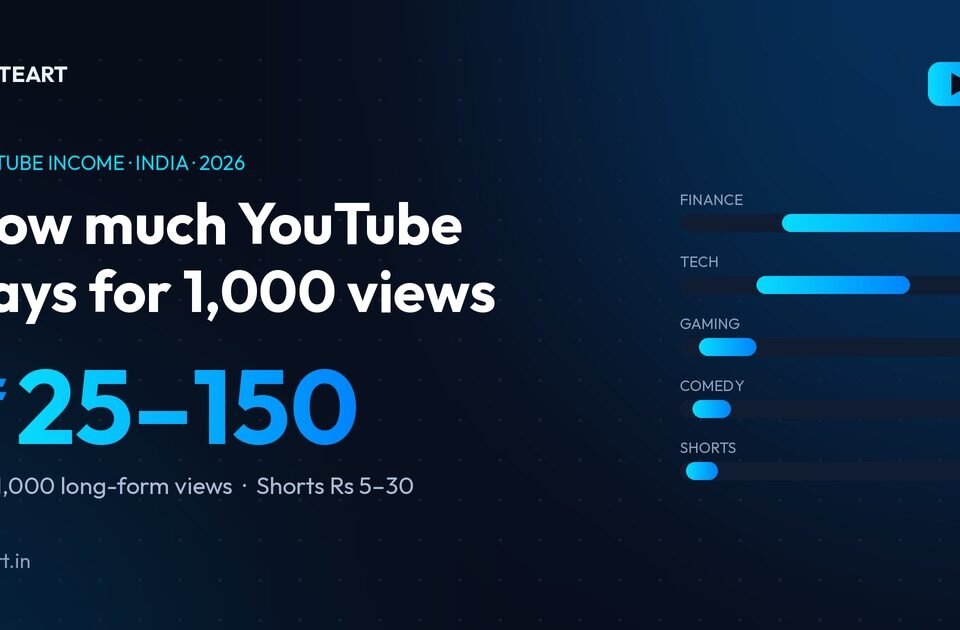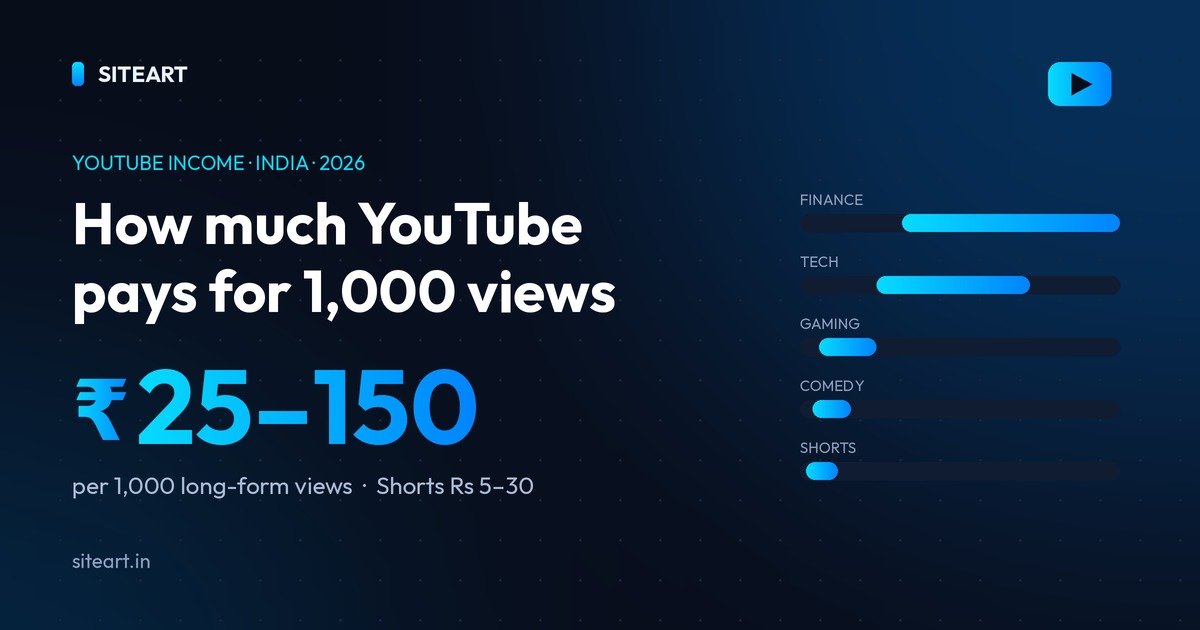
“How much does YouTube pay for 1,000 views?” is the first question every new creator asks, and the honest answer annoys people. YouTube doesn’t pay for views at all. It pays you a share of what advertisers spent to appear on your videos. Views are only how that money gets counted.
That’s why two Indian channels with the same one lakh views can earn ₹2,500 and ₹20,000 in the same month. One made gaming clips for teenagers. The other explained mutual funds to people with salaries.
This guide gives you realistic 2026 numbers for YouTube views income in India, a calculator, what actually reaches your bank after tax, and a rule change on 1 February 2027 that most older articles haven’t caught up with.
YouTube income calculator for India
Enter your views, pick the closest niche and format, and you’ll get a low and a high estimate for ad income.
The ranges come from 2026 estimates published for Indian audiences. Your own figure is in YouTube Studio under Analytics, then Revenue, shown as RPM.
YouTube views income in India: 1,000 views to 1 crore views
The same numbers as a table, for long-form videos by niche and for Shorts.
| Views | Entertainment and gaming | Tech | Finance | Shorts (any niche) |
|---|---|---|---|---|
| 1,000 | ₹10–60 | ₹60–180 | ₹80–250 | ₹5–30 |
| 10,000 | ₹100–600 | ₹600–1,800 | ₹800–2,500 | ₹50–300 |
| 1 lakh | ₹1,000–6,000 | ₹6,000–18,000 | ₹8,000–25,000 | ₹500–3,000 |
| 10 lakh (1 million) | ₹10,000–60,000 | ₹60,000–1.8 lakh | ₹80,000–2.5 lakh | ₹5,000–30,000 |
| 1 crore (10 million) | ₹1–6 lakh | ₹6–18 lakh | ₹8–25 lakh | ₹50,000–3 lakh |
How YouTube actually works out your pay
Three steps, in order.
- An advertiser pays YouTube to show an ad. The price for 1,000 ad impressions is the CPM. In India it runs from roughly ₹40 to ₹250 depending on the subject.
- YouTube keeps 45% of that on long-form videos and passes 55% to you.
- Not every view shows an ad. Some viewers use ad blockers, some videos get limited ads, and some views simply don’t get an ad served.
What’s left, divided by your total views, is your RPM: revenue per 1,000 views. That’s the only number worth planning with.
RPM by niche: who earns what per 1,000 views
| Niche | Estimated RPM (long-form) | Why |
|---|---|---|
| Finance and investing | ₹80–250 | Banks, brokers, insurers and fintech apps bid hard for people who are about to move money |
| Tech and gadgets | ₹60–180 | Phone and laptop brands advertise to viewers who are comparing models |
| Real estate, education | Upper-middle of the range | Ranked just behind finance in upGrowth’s 2026 estimates. High-value purchases, fewer advertisers |
| Gaming, music | ₹15–60 | Huge view counts, young audiences, lower ad prices |
| Comedy, entertainment, vlogs | ₹10–40 | Broad audience with no clear buying intent, so advertisers pay least |
| Shorts (any niche) | ₹5–30 | Pooled revenue and a 45% share |
If you’re choosing a subject for a new channel, this table should carry more weight than any advice about thumbnails. A finance channel needs about a sixth of the views a comedy channel needs for the same income.
Six things that move your income per 1,000 views
- Niche. Covered above. It’s the biggest lever.
- Where your viewers live. Advertisers pay far more to reach viewers in the US, UK, Canada, Australia and the Gulf than in India. A channel in English, or with English subtitles, usually picks up some of that audience.
- Video length. Videos of eight minutes or more can carry mid-roll ads. A good twelve-minute video often earns two or three times what a four-minute video on the same subject does.
- Time of year. Ad budgets rise from Navratri to the new year and during the IPL. Many creators see their best RPM between October and December and their worst in January and April.
- Language. Hindi reaches the most people. English tends to earn more per view. Regional languages have less competition, which often makes it easier to rank.
- Advertiser-friendliness. Videos with strong language, violence or sensitive news get limited ads or none.
Shorts: why they pay so little, and what changes in 2027
Shorts don’t have ads attached to individual videos. Ads run between Shorts in the feed, the money goes into one pool, music licensing is paid from that pool, and what’s left is divided by each creator’s share of views. Creators keep 45% of their allocation.
The result is ₹5 to ₹30 per 1,000 views for most Indian channels. A Short with 10 lakh views might earn ₹5,000 to ₹30,000. A long video with the same views in the same niche could earn five to ten times that.
Our advice hasn’t changed: use Shorts to be discovered, and long videos to be paid.
Who gets paid: monetisation rules now and from 1 February 2027
Views earn nothing until your channel is in the YouTube Partner Program. In August 2026 YouTube announced the biggest change to the entry rules since 2018.
| Level | What it unlocks | Until 31 January 2027 | From 1 February 2027 |
|---|---|---|---|
| Early access | Channel memberships, Super Chat, Super Thanks, Shopping | 500 subscribers, 3 public uploads in 90 days, and 3,000 watch hours in 12 months or 3 million Shorts views in 90 days | No change |
| Full monetisation | Ad revenue and YouTube Premium revenue | 1,000 subscribers, and 4,000 watch hours in 12 months or 10 million Shorts views in 90 days | 1,000 subscribers, and 8,000 qualified watch hours in 365 days or 20 million qualified Shorts views in 90 days (new applicants) |
| Shorts revenue | Share of the Shorts ad pool | No ongoing minimum once you’re in | 10 million qualified Shorts views in every rolling 90 days, for everyone |
What actually reaches your bank account
The payment cycle
YouTube pays through AdSense. Your earnings for a month are finalised between the 7th and 12th of the next month and paid between the 21st and 26th, provided your balance has crossed 100 US dollars. Below that, the money carries forward. So a small channel earning ₹2,000 a month will be paid once every four or five months.
US tax on US viewers
Google withholds US tax on what you earn from viewers in the United States. How much depends on one form.
| Your situation | What Google withholds | On $1,000 earned, $100 of it from US viewers |
|---|---|---|
| W-8BEN submitted, India–US treaty claimed | 15% of US earnings | $15 |
| W-8BEN submitted, no treaty claim | 30% of US earnings | $30 |
| No tax form submitted | Up to 24% of total worldwide earnings | $240 |
The form is in AdSense under Payments. Indian creators generally use their PAN as the tax identification number. It takes about ten minutes and saves a great deal.
Indian tax
YouTube income is taxable in India like any other income, and once your yearly receipts grow you may also need GST registration. Rules differ with your turnover and how you’re set up, so take this to a chartered accountant before your first big payment. We’re marketers, not tax advisers.
How many views you need for ₹50,000 a month
| Your RPM | Typical niche | Monthly views needed |
|---|---|---|
| ₹15 | Shorts | About 33 lakh |
| ₹30 | Comedy, gaming | About 16.7 lakh |
| ₹60 | Lifestyle, lower-end tech | About 8.3 lakh |
| ₹100 | Tech, education | 5 lakh |
| ₹150 | Finance | About 3.3 lakh |
| ₹250 | Finance with overseas viewers | 2 lakh |
Most Indian channels never reach these view counts every month, which is why creators who earn a living from YouTube rarely depend on ads. The names on our list of the richest YouTubers in India earn most of their money from sponsorships, their own businesses, live shows and courses.
Income beyond ads
- Sponsorships. A brand pays for a mention or a full video. Rates depend on niche and trust more than on subscriber count, and even small channels in specialised subjects get offers.
- Affiliate links. A commission when a viewer buys through your link. It suits tech, books, software and finance.
- Fan funding. Channel memberships, Super Chat and Super Thanks. These open at 500 subscribers, well before ad revenue does.
- Your own product or service. A course, a template, consulting, a shop. This is usually where the largest numbers come from.
If you run a business, RPM is the wrong number
We see business owners look at ₹40 per 1,000 views and decide YouTube isn’t worth the effort. They’re measuring the wrong thing.
Take an interior designer in Bengaluru who posts a video called “2BHK interior cost in Whitefield, with real bills”. It gets 4,000 views in six months. Ad income, if the channel is even monetised: perhaps ₹300. But three viewers send a WhatsApp message asking for a quote, and one signs a project worth several lakh rupees.
For a business, a YouTube video is a search result that happens to talk. People look for it, watch it when they’re close to deciding, and it keeps working for years. What you should count is enquiries, and to count them you need tracking in place: a link in the description with UTM tags, a WhatsApp click you can measure, and a form that records where the lead came from. We explain that setup in five things to fix before you spend more on ads.
Video is one of fourteen channels we compare in our guide to the types of digital marketing, and video titles and descriptions follow the same rules as our SEO work: write for what people actually type.
Sources
- NewscastStudio, YouTube tightens Partner Program requirements, raises bar for Shorts monetization (10 August 2026): thresholds from 1 February 2027, the Shorts 90-day rule, revenue shares, terms deadline.
- upGrowth, YouTube CPM in India 2026 (September 2026): CPM of ₹40–250, RPM of ₹25–150, Shorts at ₹5–30, niche ranking.
- Fluxnote, YouTube RPM in India 2026: niche ranges for finance, tech, gaming and entertainment.
- air.io, YouTube tax info for non-US creators (updated October 2026): payment calendar, $100 threshold, withholding scenarios.
- exchange4media, YouTube creators in India have to pay withholding tax on US earnings: 15% treaty rate for India.
All rupee figures are estimates for 2026 and will vary by channel. Check YouTube Studio for your own RPM and YouTube Help for the current programme rules.