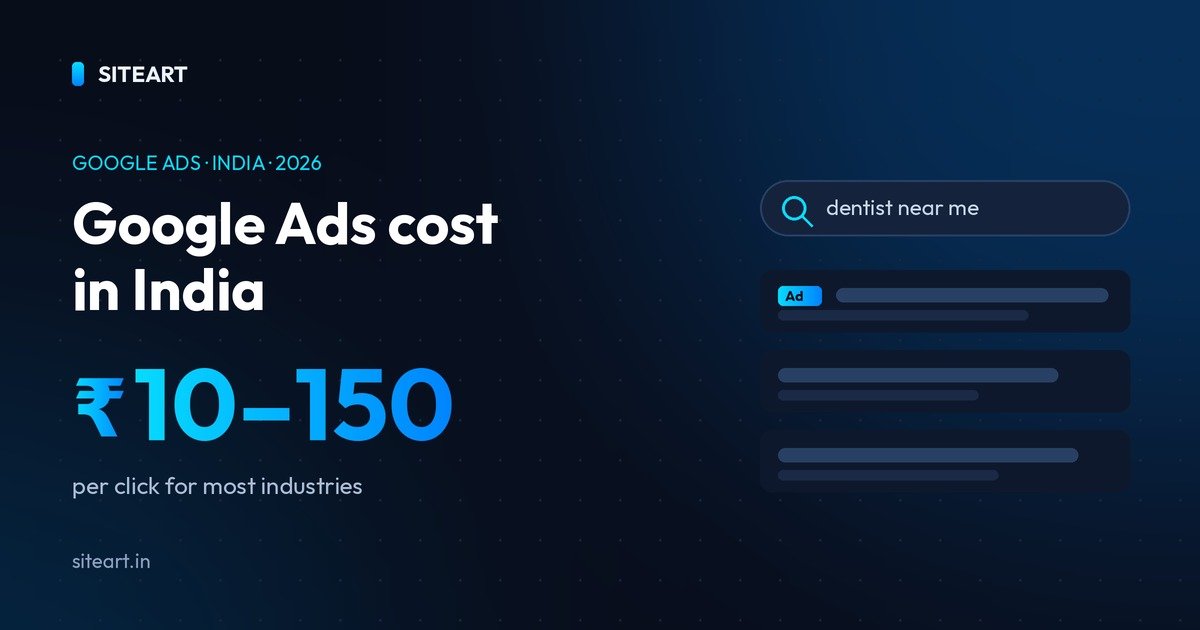
“How much do Google Ads cost?” has the same answer as “how much does a plot cost?”. It depends where, and on how many other people want it. Google Ads is an auction. Every time someone searches, businesses bid for the click, and the price moves with the competition.
That’s frustrating when you’re trying to set a budget, so this guide gives you the numbers that actually help: what clicks and leads cost by industry in India in 2026, a simple way to work out a monthly budget from the leads you need, the GST that lands on top, and what you’ll pay someone to manage it.
How Google Ads pricing works
You don’t pay to appear. You pay when someone clicks. The amount is decided by a quick auction each time a search happens, and three things shape it:
- Competition. How many advertisers want that keyword in that location, and how much a customer is worth to them.
- Quality Score. Google rewards ads and landing pages that match the search well. A strong score can lower your click cost by a fifth or more; a weak one can double it.
- Targeting choices. City, radius, time of day, device and match types all change who sees your ad and what you pay.
That’s why two dentists in Bengaluru can pay very different amounts for similar keywords. One has a fast, specific landing page and tight targeting. The other sends “dentist near me” traffic from the whole city to a slow homepage.
Google Ads cost per click and per lead by industry (India, 2026)
| Industry | Typical cost per click | Typical cost per lead | Notes |
|---|---|---|---|
| Restaurants and food | ₹10–₹25 | Low; usually calls and directions | Low click costs because orders are small |
| Ecommerce (Shopping ads) | ₹5–₹40 | Judged on return on ad spend instead | Product feed quality matters more than bids |
| Education and coaching | ₹8–₹60 | ₹150–₹1,000 | Lead forms convert well; admissions season costs more |
| Healthcare and clinics | ₹20–₹100 | ₹300–₹800 for clinics | Google restricts some healthcare ads |
| Real estate | ₹40–₹120+ | ₹500–₹2,500 | One of the most competitive verticals in India |
| Legal services | ₹40–₹150 | Varies widely | High customer value pushes bids up |
| B2B and SaaS | ₹40–₹200 | ₹1,200–₹3,500 | Long sales cycles; track beyond the first form |
| Finance, loans and insurance | ₹100–₹600+ | High | The most expensive clicks in India |
Ranges combine 2026 Indian benchmarks published by upGrowth, OwlClaw, Sotros Infotech and others. Bengaluru, Mumbai and Delhi typically cost 35 to 50% more per click than smaller cities. Check your own keywords in Google Keyword Planner before budgeting.
How to set your monthly budget
Start with the number of leads you need, not a round number you’re comfortable with. The formula is simple:
Monthly ad budget = leads you want × average cost per click ÷ landing page conversion rate
If you don’t know your conversion rate yet, 3 to 6% is a reasonable planning figure for a decent service landing page in India, and 10% or more is possible with a strong offer and a short form. Once the campaign has run for a month, replace the guesses with your own numbers.
Starting budgets that tend to work
| Business | Typical starting ad spend a month |
|---|---|
| Single-location local service (clinic, salon, coaching, repair) | ₹10,000–₹20,000 |
| Service company across a city (interiors, legal, accounting, IT) | ₹25,000–₹75,000 |
| Ecommerce store with Shopping ads | ₹30,000–₹1 lakh, judged on return on ad spend |
| Real estate project launch | ₹1 lakh–₹5 lakh+, often alongside Meta |
| B2B or SaaS lead generation | ₹50,000–₹2 lakh |
Below about ₹10,000 a month in a competitive city, you often won’t get enough clicks for Google’s automated bidding to learn, and results stay noisy. If your budget is smaller, narrow to a few high-intent keywords and a tight area around your business.
GST and tax on Google Ads in India
Your ad spend is not the full bill. Google Ads attracts 18% GST, and how you pay it depends on which Google company bills you.
| Billed by | What happens | Input tax credit |
|---|---|---|
| Google India (invoice shows an Indian GSTIN) | 18% GST is added to the invoice. Give Google your GSTIN | Registered businesses can claim it normally |
| A Google entity outside India (no Indian GST on the invoice) | A registered business pays 18% itself under reverse charge | Usually claimable once the reverse charge is paid |
Businesses billed by Google India may also have TDS obligations on large invoices. The 6% equalisation levy on online ads to foreign platforms was abolished from 1 April 2025. Tax treatment depends on your registration and billing setup, so confirm with your chartered accountant. We’re marketers, not tax advisers.
What agencies charge to manage Google Ads
Ad spend goes to Google. The management fee goes to whoever plans, builds and improves the campaigns. Always ask a proposal to show the two separately: “₹40,000 a month” could mean ₹40,000 to Google plus a fee, or ₹15,000 to Google and ₹25,000 to the agency.
| Pricing model | Typical range in India | Works best when | Watch out for |
|---|---|---|---|
| Flat monthly fee | About ₹15,000–₹75,000 for small and mid-sized accounts | Spend is steady and modest | Fixed fees that cover only setup and a monthly report |
| Percentage of ad spend | 10–20%, often with a minimum fee | Spend is growing quickly | An incentive to push your budget up |
| Hybrid | Base fee plus a smaller percentage | Mid to large accounts | Make sure the threshold and cap are written down |
A fair management fee should buy: search term reviews and negative keywords every week, ad testing, landing page feedback, conversion tracking checks, budget pacing and a report that shows leads and cost per lead, not just clicks and impressions.
Eight ways to lower what you pay
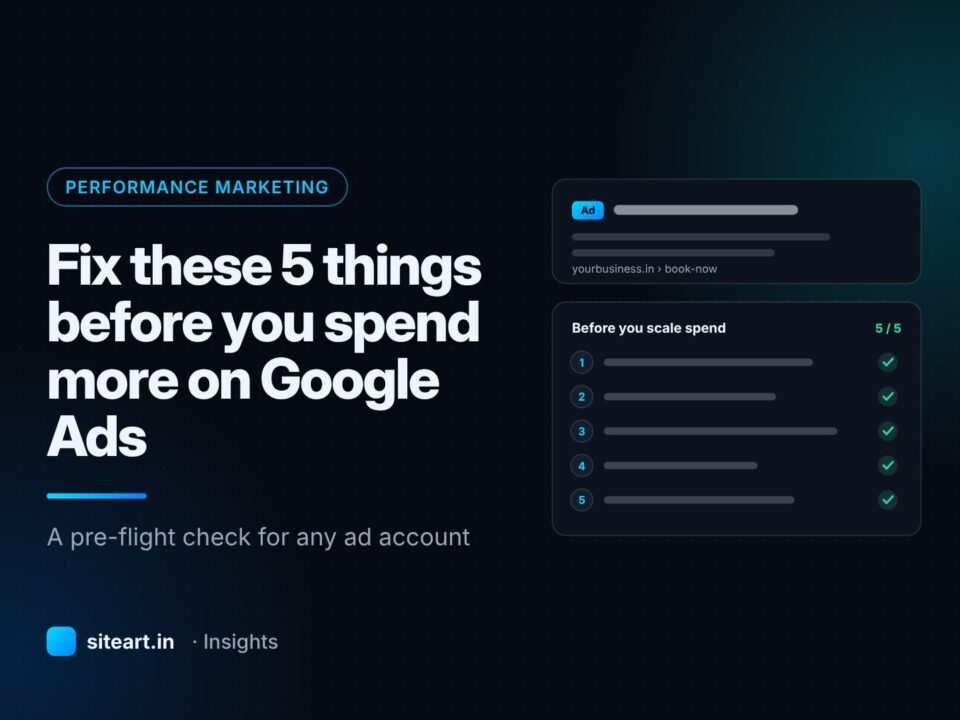
- Fix conversion tracking first. If Google can’t see which clicks became enquiries, its bidding optimises for clicks, not customers. See our five fixes before spending more on Google Ads.
- Send each ad group to a matching page. “Root canal treatment in Jayanagar” should land on a root canal page that mentions Jayanagar.
- Add negative keywords every week. Words like “free”, “jobs”, “course” and “salary” waste money for most service businesses.
- Narrow the area. A 5 km radius around a clinic usually beats “all of Bengaluru”.
- Schedule ads for when you can answer. A call that rings out at 10 pm is a paid lead lost.
- Use specific, longer keywords. They cost less and bring buyers who know what they want.
- Improve Quality Score. Relevant headlines, a fast mobile page and a clear offer lower click costs over time.
- Respond fast. A lead called in five minutes is far more likely to convert than one called tomorrow. That’s a real reduction in cost per customer.
Tag every ad link with UTM parameters so your analytics and CRM know where each enquiry came from. Our free UTM builder does it in seconds.
Google Ads or Meta ads?
Google Search reaches people who are already looking, so leads cost more but are closer to buying. Facebook and Instagram reach people who aren’t searching yet, at a lower cost per lead, and need faster follow-up and better qualification. Most businesses get the best results using Search to capture demand and Meta to create it. Our guide to the types of digital marketing compares the channels side by side, and our real estate digital marketing guide shows how the two work together in one of the most competitive categories.
How Siteart runs Google Ads
We start with tracking and the landing page, because that’s where most wasted budget hides. The account stays in your name, the fee is shown separately from ad spend, and every report leads with enquiries and cost per lead. See our PPC advertising service or ask for an account review.
Sources
- upGrowth, Google Ads pricing India 2026: cost per click ranges by industry, GST and agency fees.
- OwlClaw, PPC benchmarks India 2026: real estate and education click costs, cost per lead benchmarks.
- Sotros Infotech, Google Ads cost per lead India 2026 (June 2026): cost per lead by industry, city tier multipliers, Quality Score effect.
- OneCity Technologies, Google Ads cost in Bangalore: Bengaluru click costs and starting budgets by business type.
- ClearTax, GST and TDS on Google Ads, and CAclubindia, GST entry for Google invoices: forward charge, reverse charge and the end of the equalisation levy.
Click and lead costs are 2026 market estimates and change with competition and season. Tax notes are general information, not tax advice.