Every developer we speak to has the same dashboard problem. Leads are coming in. The cost per lead looks fine. And the sales team says the leads are rubbish.
Both sides are usually right. Real estate is the one category where the cheapest lead and the best lead are almost never the same person, where a buyer takes months to decide, and where a single booking can be worth more than a year of ad spend. That changes how digital marketing has to be run.
This guide covers how property marketing works online in India in 2026: which channels do what, what a lead really costs, how to set a budget from your booking target instead of a round number, the RERA rules your ads must follow, and the follow-up habits that decide whether any of it pays off.
What real estate digital marketing actually involves
For a developer, a builder or a channel partner, the job breaks into four parts. Miss any one and the others underperform.
- Demand capture. Being in front of people who are already looking: Google Search for “3 BHK in Sarjapur Road”, property portals, and your project name in search results.
- Demand creation. Reaching people who will buy in the next year but aren’t searching today: Meta ads, YouTube walkthroughs, Instagram content and retargeting.
- Conversion. A landing page or WhatsApp conversation that answers price, configuration, location and possession date, then asks for one thing: a call back or a site visit.
- Follow-up and attribution. A CRM that receives every lead in seconds, routes it to a salesperson, records the outcome and tells you which campaign produced which booking.
Most underperforming campaigns we see are strong on the first two and weak on the last two. The ads work. The leads sit for six hours before anyone calls.
The main channels, and what each is good for
| Channel | Typical cost per lead (India, 2026) | Lead quality | Best used for |
|---|---|---|---|
| Google Search ads | ₹300–₹2,500 | High. The buyer typed the location or project | Capturing active buyers by micro-market and configuration |
| Meta lead ads (Facebook, Instagram) | ₹150–₹2,000 | Mixed. Needs qualifying questions | Volume, launches, reaching buyers before they search |
| Click-to-WhatsApp ads | Often lower effective cost than forms | Good when answered fast | Starting a real conversation instantly |
| Property portals (99acres, MagicBricks, Housing.com) | Package or per-response pricing; varies by locality | Active comparers, often enquiring with many sellers | Visibility where buyers already browse listings |
| YouTube and video | Usually used for reach, not direct leads | Builds trust before a visit | Walkthroughs, location videos, construction updates |
| SEO and your website | No per-lead cost once ranking | High, and compounding | Project and locality pages that keep bringing enquiries |
| Retargeting | Low | Warm | Bringing back people who visited the page or chatted once |
Cost ranges are the working figures published by Sell.do in August 2026 for Indian real estate teams. Your own figures will depend on city, ticket size, creative and follow-up speed.
Bengaluru benchmarks
For Bengaluru specifically, published 2026 benchmarks from local agencies put mid-segment Meta leads at roughly ₹300 to ₹1,000 and Google Search leads at roughly ₹800 to ₹2,500. Villas, plots in premium layouts and projects above ₹2.5 crore run higher on both. If your numbers are far below these ranges, check lead quality before celebrating. If they’re far above, check your landing page before blaming the platform.
Google Search: where intent lives
Someone typing “2 BHK ready to move Whitefield under 90 lakh” has told you their configuration, location, budget and timeline in one line. That’s why search leads cost more and close better. Three things make the difference:
- Build campaigns around micro-markets and configurations, not generic “flats in Bangalore”. Separate ad groups for location plus BHK, project name, and nearby landmarks such as tech parks.
- Send each search to a matching page. A “3 BHK Hennur” search should land on a page that shows 3 BHK plans, prices and Hennur connectivity, not your homepage.
- Use Performance Max carefully. It spends easily and can push budget into cheap placements that produce poor leads. Anchor the account on Search and treat Performance Max as a supplement with exclusions in place.
Meta ads: volume, creative and qualification
Meta is where most real estate leads come from by volume, and where most junk comes from too. The fixes are known:
- Qualify inside the form. Ask budget range, preferred configuration and when they plan to buy. Each question lowers the lead count and raises the share worth calling.
- Keep geography tight. Broad audiences with a sensible radius around the project and the buyer’s likely workplaces usually beat long lists of interests.
- Change creative often. Walkthrough videos, price-led carousels and possession-date messages tire quickly. Rising cost per lead is usually an ad problem, not an audience problem.
- Test Click-to-WhatsApp. Indian buyers prefer a chat to a form. A conversation that starts immediately gets answered far more often than a form that waits in a queue.
Property portals: treat them like any other paid channel
99acres, MagicBricks and Housing.com are among the most visited property sites in India, and buyers use them to compare. That makes them useful, and it also means the same buyer often enquires with five or six sellers in an evening. The builders who get value from portals respond first, track portal leads in the same CRM as everything else, and compare portals on cost per site visit by micro-market. Often one portal quietly outperforms the others for a given location.
Your website and SEO: the channel that doesn’t switch off
Ads stop the day the budget stops. A project page that ranks for “new apartments in Devanahalli” keeps bringing enquiries for the life of the project. Every project deserves its own page with RERA details, configurations, price bands, floor plans, a location map with real travel distances, construction updates and a quick enquiry option. Locality guides and honest comparison pages help both Google and AI tools recommend you. Our SEO work for property clients starts with exactly these pages, and we explain how AI answers pick sources in AEO and GEO explained.
How to set a budget: work backwards from bookings
“How much should we spend?” is the wrong first question. Start with how many units you need to sell, then use your own conversion rates to work out how many leads that takes.
Here’s an illustrative example. The rates are assumptions to show the method; use your own CRM history if you have it.
| Step | Assumption | Result |
|---|---|---|
| Bookings needed this quarter | Target | 15 bookings |
| Site visits needed | 1 in 8 visits books (12.5%) | 120 site visits |
| Qualified leads needed | 1 in 12 leads visits (about 8%) | 1,440 leads |
| Media budget | Blended ₹700 per lead | About ₹10 lakh |
| Cost per booking | Budget ÷ bookings | About ₹67,000 |
Now the useful part. If your follow-up improves and 1 in 8 leads visits instead of 1 in 12, you need 960 leads, and the same 15 bookings cost about ₹6.7 lakh. That’s a ₹3.3 lakh saving without touching the ad account. This is why follow-up speed is a marketing number, not just a sales one.
How to split the budget across channels
There’s no universal split. A sensible starting point for a single active project, suggested by Sell.do, is roughly 40% on Google Search, 35% on Meta with a good share of it on Click-to-WhatsApp, and 25% on whichever portals perform best in your micro-market. Then rebalance every month on cost per site visit and cost per booking, never on cost per lead alone.
Follow-up: where most of the money is won or lost
A paid lead that nobody calls for six hours is budget thrown away. A lead called within a minute or two is far more likely to answer, remember the ad and agree to a visit. If a quarter of your leads are never properly contacted, your real cost per lead is a third higher than the dashboard says.
- Send every lead straight into one CRM from Meta, Google, portals, your website and channel partners, with its source tagged at the moment it arrives.
- Acknowledge on WhatsApp automatically within seconds, with the brochure and a link to book a visit.
- Call fast. Set a target of a few minutes and alert a manager for any lead untouched after fifteen.
- Make several attempts across a few days at different times. Many buyers answer on the third try.
- Send outcomes back to the ad platforms. When Google and Meta learn which leads became site visits and bookings, they start finding more people like them.
AI voice agents and WhatsApp assistants can now handle the first response and basic qualification around the clock, then pass warm leads to a person. They work best as a speed layer in front of your sales team, not as a replacement for it.
RERA rules for real estate advertising
Property ads in India are regulated, and regulators have become far stricter. This is not legal advice, but every campaign should be checked against these basics:
- Advertise only registered projects and show the RERA registration number in every ad, brochure, landing page and hoarding. Karnataka RERA requires the number on all advertisements for registered projects.
- Add the project QR code where your state requires it. Maharashtra, Tamil Nadu, Uttar Pradesh and Kerala have made a QR code linking to the project’s RERA page mandatory in ads, and MahaRERA has fined developers for missing it.
- Keep claims accurate. Travel times, amenities, possession dates and prices must match what’s registered. Tamil Nadu’s regulator has specifically clamped down on misleading travel-time claims and vague disclaimers.
- Brokers and channel partners should show their own agent registration number where the state requires it.
Seven mistakes that waste real estate budgets
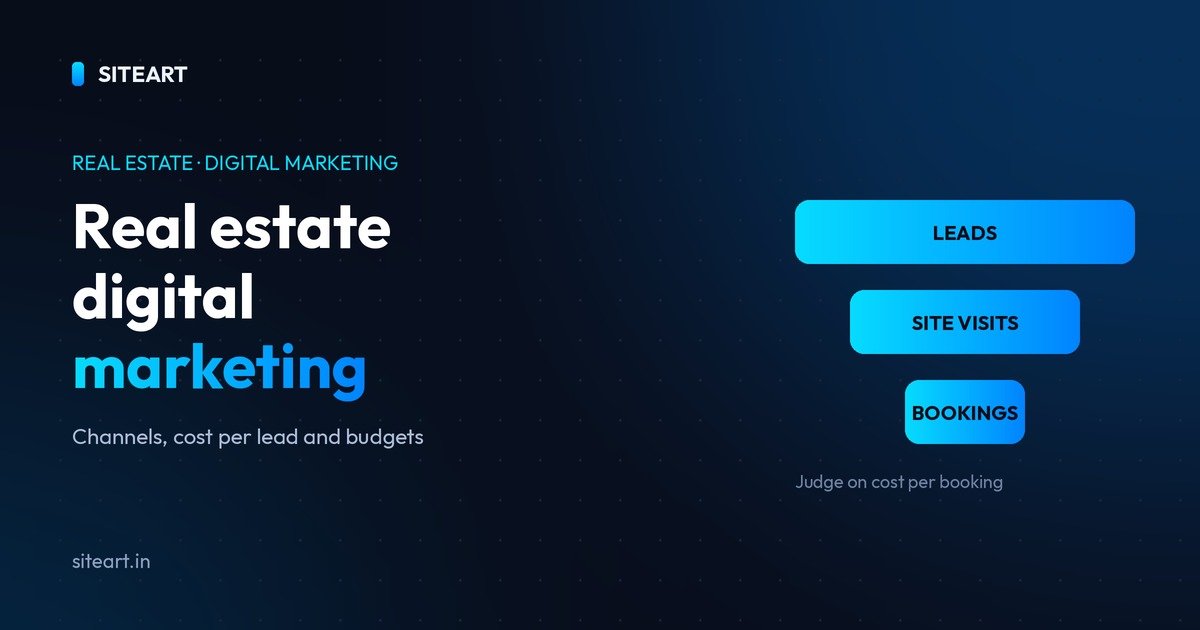
- Judging campaigns on cost per lead. A ₹150 lead that never answers is more expensive than a ₹900 lead that books.
- Sending every ad to the homepage. Match each campaign to a project or configuration page.
- No price on anything. Hiding the price attracts people who can’t afford the project.
- Slow follow-up. The buyer who enquired with five builders tends to visit the one who called first.
- Leads in spreadsheets and phones. If you can’t trace a booking back to its campaign, you can’t decide where the next rupee goes.
- Same creative for months. Fatigue quietly raises costs every week.
- Skipping the RERA details. It’s a compliance risk, and buyers increasingly check.
What to track every week
| Metric | How to calculate | Why it matters |
|---|---|---|
| Cost per lead | Spend ÷ leads, by channel and campaign | Early warning only |
| Contact rate | Leads reached ÷ leads received | Shows follow-up leakage |
| Lead-to-visit rate | Site visits ÷ leads | The best single measure of lead quality |
| Cost per site visit | Spend ÷ site visits | Compare channels on this |
| Visit-to-booking rate | Bookings ÷ site visits | Measures the sales experience and the product |
| Cost per booking | Spend ÷ bookings | The number your management actually cares about |
None of this works without clean tracking on your site and landing pages. Our checklist of five things to fix before spending more on Google Ads covers the setup, and our free UTM builder tags every link so the CRM knows where each lead came from.
How Siteart helps property brands
We run real estate campaigns end to end: project and locality landing pages, Google and Meta campaigns built around micro-markets, Click-to-WhatsApp flows, CRM integration with source tagging, and weekly reporting on cost per site visit and cost per booking. If you have a launch coming up, see our performance marketing service or talk to us about your project.
Sources
- Sell.do, Paid lead gen for Indian real estate (2026) (updated 10 August 2026): cost per lead ranges for Meta and Google, Click-to-WhatsApp effect, budget split, follow-up and attribution practice.
- Nuwizo, Facebook and Google ads for real estate in India (2026): Bengaluru mid-segment cost per lead benchmarks and launch budgets.
- Beta Digital Marketing, Real estate digital marketing in Bangalore: Bengaluru Google and Meta cost per lead ranges.
- Dwello, Karnataka RERA rules on advertising and marketing: registration number requirement in advertisements.
- Free Press Journal, MahaRERA fine for missing QR codes, and Storyboard18, TNRERA guidelines on misleading ads: state QR code and advertising rules.
Cost ranges are published 2026 market benchmarks and will vary by project. The budget example uses illustrative conversion rates. RERA requirements differ by state; check your regulator’s current guidelines.