Ask five people in Bengaluru what a website costs and you’ll get five honest answers that sound like they’re about different things. A cousin built one for ₹8,000. A freelancer quoted ₹35,000. An agency sent a proposal for ₹1.8 lakh. Someone on Instagram says you can do it yourself for ₹69 a month.
They’re all telling the truth. They’re just pricing different amounts of work, and almost nobody tells you what’s inside the number. We write and receive a lot of these quotes, so this guide does the boring part properly: what each budget actually buys, what you’ll keep paying every year, and how to put three quotes side by side without being fooled by the cheapest first invoice.
Website cost in India by type of website
Start here. Find the row that sounds like your business, then read the next section to see where in the range you’re likely to land.
| Type of website | Typical 2026 build cost | What you usually get | Good for |
|---|---|---|---|
| Basic site, 1 to 5 pages | ₹5,000–₹30,000 | A template with your logo, text and photos, a contact form, WhatsApp button | A tutor, a clinic, a local shop, a first web presence |
| Small business site, 5 to 15 pages | ₹15,000–₹80,000 | Customised theme, service pages, blog, basic SEO setup, Google Analytics | Consultants, restaurants, builders, service companies |
| Custom-designed business site | ₹80,000–₹1.5 lakh | Original design, written copy, speed work, tracking, schema, more revision rounds | Growing companies where the site does real sales work |
| Online store | ₹40,000–₹4 lakh+ | Shopify or WooCommerce, payment gateway, shipping, GST invoices, product pages | D2C brands and retailers selling online |
| Real estate or listings site | ₹80,000–₹2 lakh+ | Property pages, filters, enquiry forms tied to a CRM, floor plans and maps | Developers, brokers, portals |
| Custom web app or platform | ₹2.5 lakh–₹10 lakh+ | Logins, dashboards, databases, integrations, built from scratch | Startups, SaaS, internal tools |
Ranges combine 2026 figures published by Hostinger, Indian development studios and our own experience of quotes in the market. They are build costs only; yearly running costs are covered further down.
If you want a number for your own project in under a minute, our free website cost calculator gives a range based on page count, features and who builds it.
Who builds it changes the price more than what you build
The same ten-page site can cost ₹8,000 or ₹1.5 lakh. The difference is usually not the page count. It’s who is doing the work and how much of the job they take on.
| Route | Upfront cost | Yearly cost after | What you’re really paying for | The catch |
|---|---|---|---|---|
| Do it yourself on a website builder | ₹0 | ₹2,500–₹7,500 | Hosting, templates and security in one subscription | Your time. Limited design and features. Hard to move later |
| Do it yourself on WordPress | ₹0–₹7,000 for a theme | ₹3,000–₹15,000 | Full control and thousands of plugins | You handle updates, backups and security |
| Freelancer | ₹10,000–₹1.5 lakh | ₹4,000–₹15,000 | One person’s design and build time | Quality varies widely. Support depends on them staying available |
| Small studio | ₹25,000–₹1.5 lakh | ₹8,000–₹25,000 | A small team, a process, some strategy | Ask who actually writes the code |
| Full-service agency | ₹50,000–₹4 lakh+ | ₹15,000–₹60,000 | Design, copy, SEO, tracking, project management, support | You pay for overhead. Worth it only if you use the extra work |
Freelancers in India commonly charge about ₹500 to ₹3,000 an hour, and agencies bundle that time with design, management and revision rounds. Neither is automatically better value. A strong freelancer with a clear brief often beats a large agency that hands your project to its most junior developer.
Seven things that push the price up or down
- Template or custom design. Adapting a good premium theme is the biggest saving available. Designing from scratch typically adds 30 to 50% to the build.
- Number of unique page layouts. Ten pages that share two layouts cost far less than ten pages each designed differently. Count layouts, not pages.
- Copywriting. If you supply finished text and photos, the job shrinks. If the vendor writes it, expect ₹5,000 to ₹30,000 more, and expect it to be worth it if they know your industry.
- Integrations. Each connection to a CRM, booking system, WhatsApp API or courier service usually adds ₹8,000 to ₹25,000.
- Languages. A site in English and Kannada or Hindi typically costs 15 to 25% more for the second language’s setup and testing.
- Migration. Moving from an old site means redirects and content transfer, often ₹10,000 to ₹30,000. Skipping redirects is how sites lose their Google rankings overnight.
- Deadlines and unclear scope. A rushed timeline costs more. So does a brief that changes every week. Every unclear decision becomes a paid revision later.
What you actually get at each budget
Under ₹15,000
Usually a pre-built theme with your logo, text and photos dropped in, on cheap shared hosting. It goes live fast and it does the basic job of proving you exist. What it usually lacks: mobile testing, speed work, analytics, a sitemap submitted to Google, and anyone to call when an update breaks something. It’s a reasonable first site for a kirana store or a home tutor. It won’t compete with a competitor who spent ₹1 lakh properly.
₹15,000 to ₹50,000
The sweet spot for most small businesses. A premium WordPress theme customised to your brand, 8 to 20 pages, a blog, contact and WhatsApp enquiries, Google Analytics and Search Console set up, basic on-page SEO and reasonable speed. You’ll often supply the text yourself.
₹50,000 to ₹1.5 lakh
Here you start paying for thinking, not just building. Custom design or heavy customisation, copy written for your customers, proper conversion tracking, schema markup, speed optimisation, a few integrations and a support period after launch. This is where a site stops being a brochure and starts producing enquiries you can measure.
₹1.5 lakh and above
Online stores with real catalogues, real estate sites with listings and CRM connections, multi-language sites and custom applications. At this level, ask for a written scope, milestones and a fixed change-request process before you sign.
The yearly costs nobody puts on the first invoice
The build fee is a one-time cost. These come back every year, and they’re where cheap quotes quietly become expensive.
| Running cost | Typical yearly cost | Watch out for |
|---|---|---|
| Domain (.in or .com) | ₹500–₹1,500 | ₹1 first-year offers. Hostinger India listed .in at ₹1 renewing at ₹899, and .com at ₹1 renewing at ₹1,499, in August 2026 |
| Hosting | ₹2,000–₹12,000 | Intro prices on long terms. A ₹69-a-month plan was renewing at ₹289 a month in November 2026 |
| Premium theme and plugins | ₹3,000–₹15,000 | Licences that expire and stop updating, which becomes a security risk |
| Business email | ₹1,000–₹2,000 per person | Using a Gmail address on a business card |
| Maintenance and support | ₹1,500–₹25,000 | No one responsible for updates and backups until the site breaks |
| Online store platform | Shopify from ₹1,499 a month plus GST; WooCommerce hosting ₹5,000–₹15,000 a year | App subscriptions and 2 to 3% payment gateway fees on every order |
Compare quotes on the 3-year total
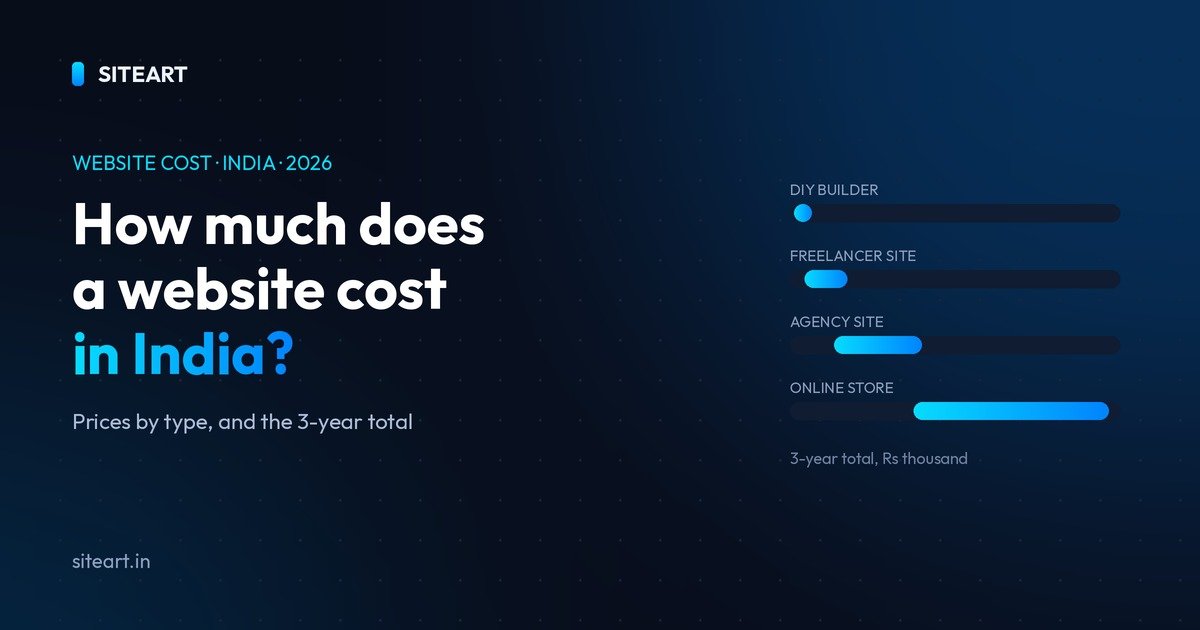
A ₹12,000 quote can end up costing more than a ₹45,000 one if the cheaper site has to be rebuilt in year two. The fair way to compare is to add the build fee to three years of running costs.
Two worked examples make the point. A ₹1.5 lakh agency site with ₹15,000 a year of hosting and support costs about ₹1.95 lakh over three years. A ₹6,000-a-year website builder costs ₹18,000 over the same period. If the builder does everything you need, it’s the better deal by a long way. If it can’t take bookings, track enquiries or rank for your services, the cheaper site is the expensive one.
Online store costs: Shopify vs WooCommerce in India
Ecommerce is where running costs matter most, because some of them grow with every order.
| Cost | Shopify | WooCommerce (WordPress) |
|---|---|---|
| Platform | Basic plan from ₹1,499 a month plus 18% GST | Free software |
| Hosting | Included | ₹5,000–₹15,000 a year for decent store hosting |
| Build by a studio | ₹25,000–₹75,000 for a standard store | ₹35,000–₹1 lakh for a standard store |
| Apps or plugins | Monthly app fees that add up quickly | ₹2,000–₹10,000 a year per premium plugin |
| Per-order fees | Payment gateway 2–3%, plus a Shopify fee when you use a third-party gateway | Payment gateway 2–3% |
| Best for | Owners who want simplicity and no server management | Owners who want control and lower fees at higher volumes |
A rough rule from Indian store builders: below a few lakh rupees in monthly sales, Shopify’s simplicity is usually worth its fees. Above that, WooCommerce often works out cheaper. If you sell on marketplaces too, our guides to Amazon Brand Registry and Meesho seller registration cover the other side.
Eight questions to ask before you pay anyone
- Will the domain and hosting be registered in my name? If the developer owns them, they effectively own your website.
- Do I get the admin login and the files? You should be able to move to another developer without asking permission.
- Can you show me three live websites you built? Live links, not screenshots. Open them on your phone.
- Is GST included in this number? An 18% difference is not small.
- How many revision rounds are included? And what does an extra one cost?
- Is SEO setup and tracking included? Ask specifically for Search Console, Google Analytics, a sitemap and enquiry tracking.
- What happens after launch? How long are bugs fixed for free, and what does monthly support cost?
- Who writes the content? Most project delays come from waiting for text and photos, not from development.
The part of the budget that brings the enquiries
A website that nobody finds is a business card in a drawer. Plan a little budget for after launch, even if it’s small.
- Tracking from day one. If you can’t tell which page or ad produced an enquiry, you can’t improve anything. See the five tracking fixes in our Google Ads checklist.
- Search. Service pages written around what customers actually type, a Google Business Profile, and a few articles answering real questions. This is the core of our SEO work, and increasingly it decides whether AI tools mention you too. We explain that in AEO and GEO explained.
- One paid channel to start. Search ads for people already looking, or social ads for awareness. Our guide to the types of digital marketing compares fourteen channels and their real costs.
How we price websites at Siteart
We quote from a written scope, not a guess. Before we give a number we ask what the site has to do for the business, which pages and features it needs, who supplies the content, and how enquiries will be tracked. You get a breakdown by item, the yearly running costs written out, and the domain and hosting in your name. If a website builder would do the job better for your budget, we’ll tell you that too.
If you’d like a quote, start with our web design page or send us your brief.
Sources
- Hostinger, How much does a website cost in India in 2026? (updated February 2026): price ranges by website type, freelancer and agency rates, hosting, plugin and maintenance costs.
- Ravi Rai on DEV Community, Website development cost in India 2026: real prices from a dev agency: studio pricing, integration and migration add-ons, what sub-₹15,000 sites include.
- Zoutons, Hostinger domain price India 2026 (29 August 2026): first-year and renewal prices for .in and .com.
- echai.ventures, Domain and hosting (checked 11 November 2026): Hostinger India hosting intro and renewal prices.
- productgrowth.in, Shopify: Basic plan at ₹1,499 a month on Shopify’s India pricing page (October 2026).
Prices are 2026 market estimates for India and will vary by city, vendor and scope. Platform and hosting prices change often, so check the provider’s current page before you buy.